
An app built
for the ADHD brain.
In short, concrete steps that fit into real life.
The app is available now for iPhone and Android. Buy here and we’ll email you the install link. The first week is free.
Take the free assessment
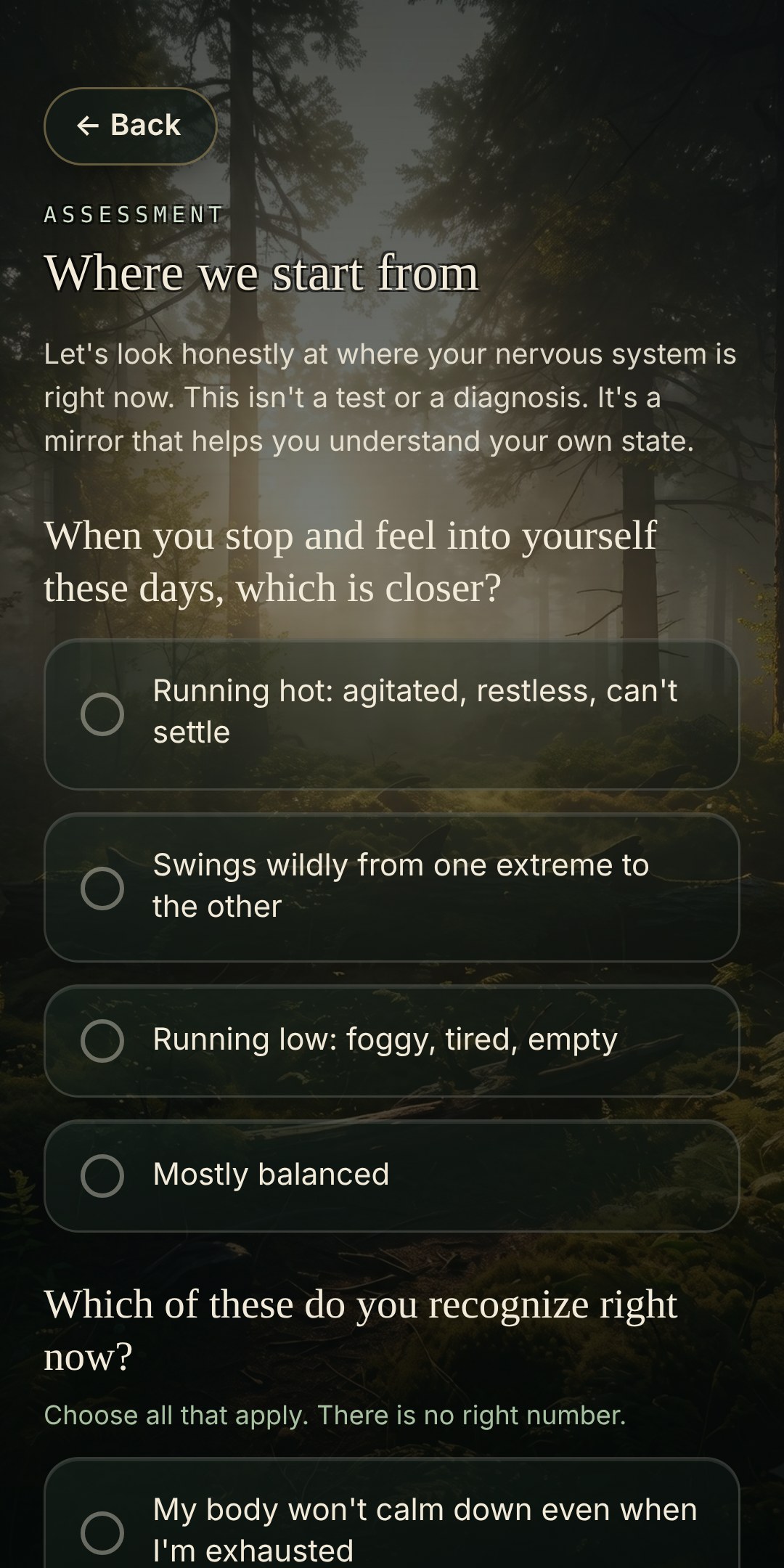
Eleven situations, about three minutes. No scales and no right answers, just a question of whether you recognize yourself.
At the end you see your own radar chart: where your capacity is and where your nervous system’s regulation is. The two are usually not at the same level, and that gap explains more than any personality trait.
In the app, a four-week guided path begins after the assessment.
You have a Ferrari engine with bicycle brakes. This program doesn’t fix you. It teaches you to drive. A person’s problem isn’t knowledge or strategy, it’s the state of the nervous system.
Four things that carry you through the day.
Assessment
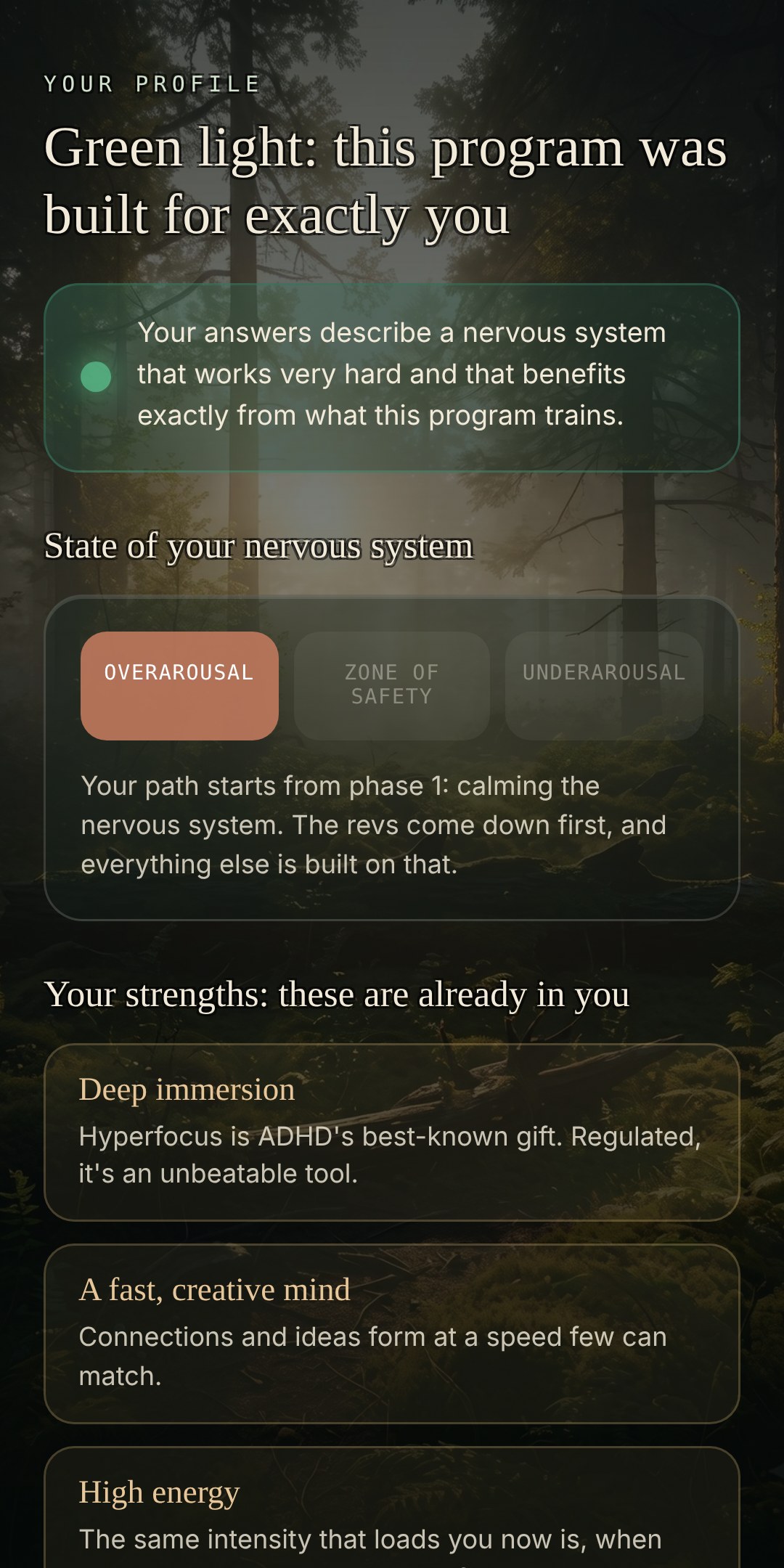
You see the current state of your nervous system and your strengths. After that, a four-week guided path begins.
SOS button
An SOS button for acute moments, because life always brings surprises. When your revs run away, you’re stuck or emotions hit hard, press SOS.
Your own routine
After four weeks you build your own routine around your needs, again and again. The journey carries on from a place of calm.
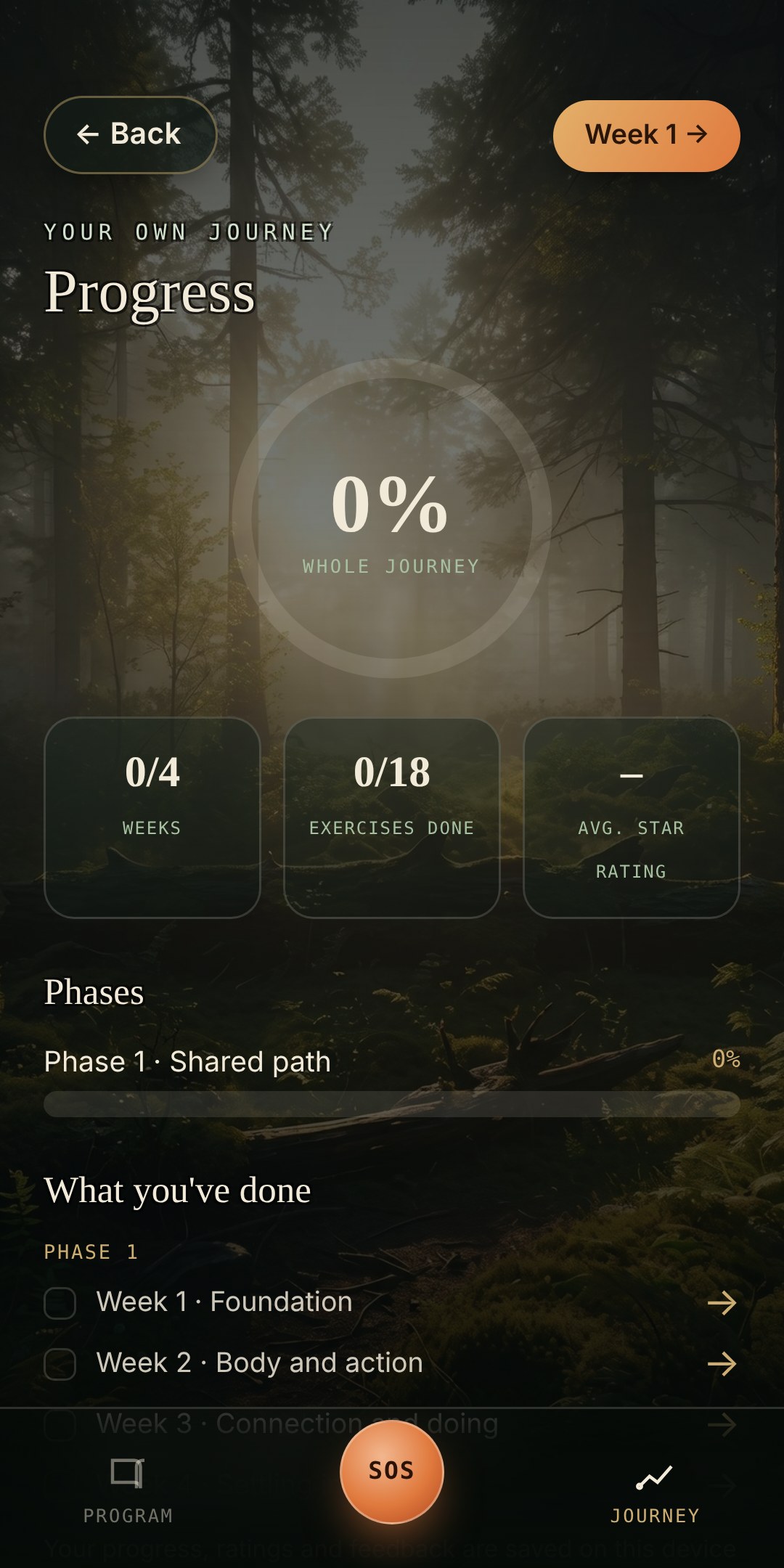
Track your progress
You always see in real time what you’ve done and what you haven’t. Your own commitments and power phrases are saved too, and you can get push reminders from them.
Living your life from active calm.
In ADHD life, the nervous system seeks variety and intensity, dopamine, from wherever it’s cheapest: the phone, interruptions, impulse purchases, drama.
This program’s job is to satisfy the same need inside a structure: novelty, intensity and wins every day, but guided.
In ADHD the core challenge is regulating arousal and emotional state, not a lack of knowledge. Every person with ADHD knows what they should do: starting, continuing and finishing collapse on the state of the nervous system, not on understanding.
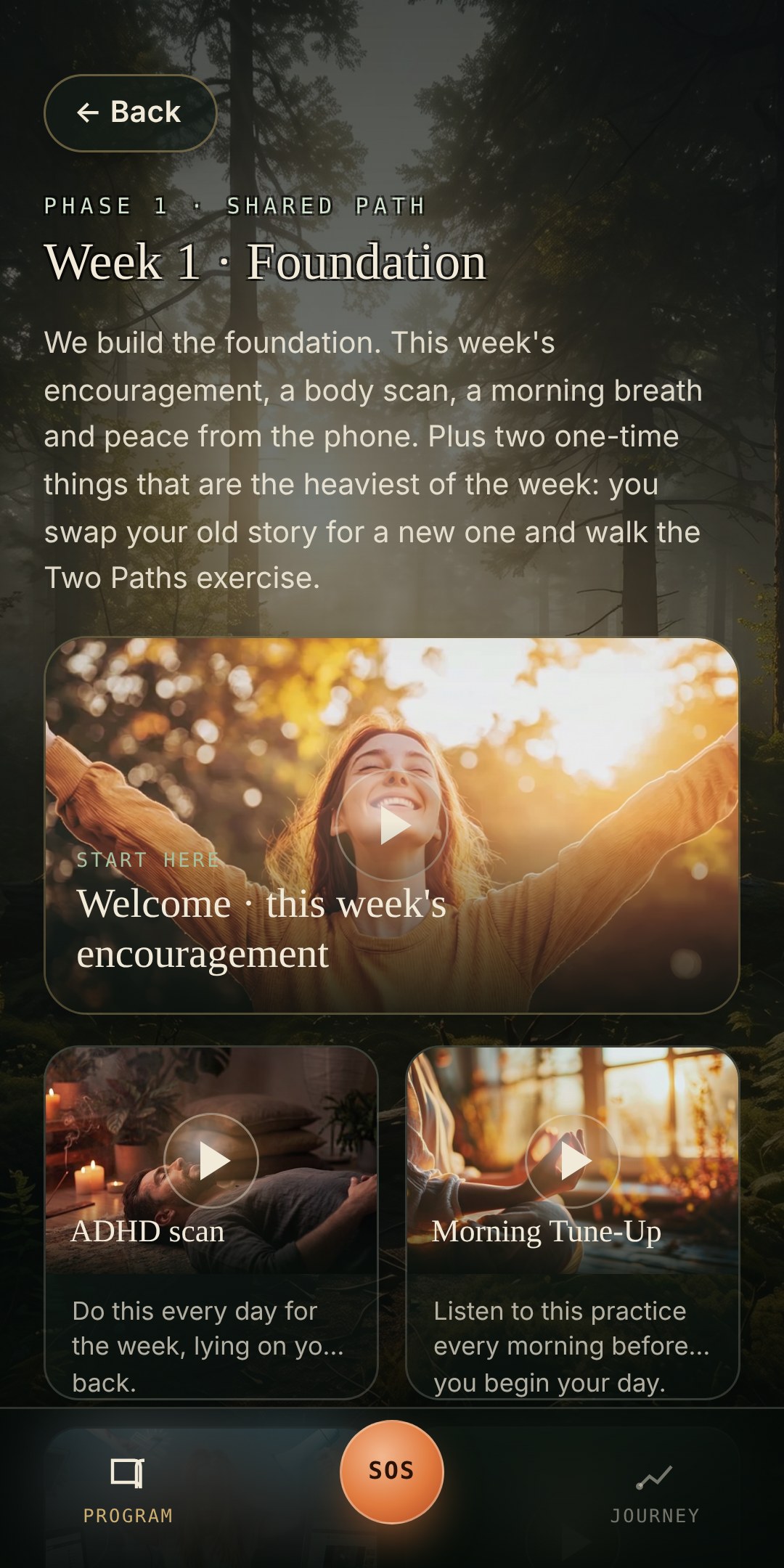
The four-week program starts from the foundation.
What is this really about?
You don’t need a new calendar. You need a new state of your nervous system, from which any calendar works.
And remember: movement creates emotion. You can’t think yourself into a new state, but you can breathe and move your way there in 90 seconds. That’s why this program starts from the body, not the calendar.
What really happens behind the breath.
Four cards on how breathing and deep rest affect the brain and nervous system. Open a card to see the whole picture.
Breathing isn’t ”relaxation”, it’s a remote control for the brain

Losing focus or brain fog are not character flaws but brain-chemical states. The rhythm of the breath is the fastest known physical route to changing the brain’s arousal and bringing back lost focus. Read how conscious breathing repairs attention.
Modern brain research has revealed the neurological core of breathing. The rhythm of inhaling and exhaling is directly linked to the locus coeruleus, a nucleus in the brainstem. This area is responsible for producing noradrenaline, which directly regulates attention and arousal (and is the same messenger most ADHD medications act on). Certain breathing rates (such as 5.5–6 breaths per minute) stimulate the vagus nerve, which balances the nervous system into the optimal state for sustaining focus.
What it feels like in practice
Lab results only gain meaning in daily life. In users’ experiences the same thing repeats: when concentration falls apart in the afternoon, or starting a task feels like an insurmountable ”wall”, rhythmic breathing brings back control. It doesn’t remove ADHD itself, but it cuts through the physical anxiety and the feeling of being squeezed. It creates a moment of clarity in the brain fog, enough to open the laptop and begin.
Scrolling social media isn’t rest. NSDR is.
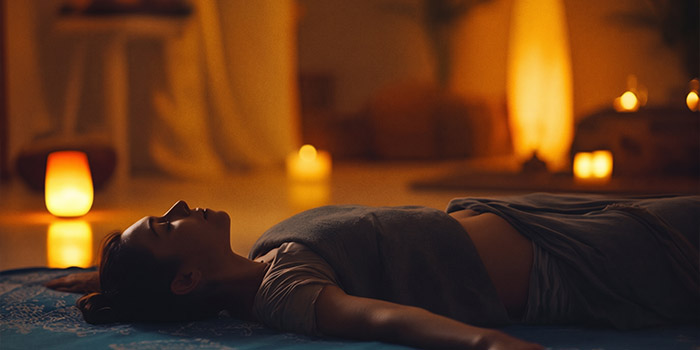
Because of a dopamine shortage, the ADHD brain constantly looks for new stimulation. That’s why ”resting” often feels impossible. NSDR (Non-Sleep Deep Rest) is a researched deep-relaxation state that lowers overarousal and activates the brain’s reward system naturally. Read how recovery is built properly.
NSDR, rooted in Yoga Nidra practice, is today a key part of effective nervous-system recovery. Brain imaging studies (PET and EEG) have found that guided deep relaxation changes the brain’s electrical and chemical activity. Brain waves slow from active beta waves to restorative alpha and theta waves. At the same time the state activates centers of the brain’s reward system (the ventral striatum), increasing the body’s own (endogenous) dopamine release without an external, addictive stimulus.
What it feels like in practice
Many believe they can’t stay still for 20 minutes. Surprisingly, it’s exactly the neuroatypical nervous system that benefits most from guided NSDR. Because the practice is voice-guided, the brain doesn’t have to attempt the impossible, to ”not think”. The voice gives the restless mind an anchor while the body is guided into a deep parasympathetic state of rest. Users describe the experience as a brain reboot: the compulsive need to chase quick dopamine hits from the phone fades, and a calm, motivated feeling rises in its place.
When the mind gets stuck, change the body’s physiology

Anxiety or strong emotional surges can’t be solved by thinking, because the nervous system is in ”fight or flight”. The physiological sigh (Cyclic Sighing) bypasses thinking and switches off the nervous system’s alarm state within minutes. Read how you cut overarousal physiologically.
In a 2023 clinical trial from Stanford University (Cell Reports Medicine), 5 minutes a day of ”cyclic sighing” (two inhales, one long exhale) lowered participants’ anxiety and arousal considerably more effectively than traditional meditation. The mechanism is physiological: the double inhale opens the lung’s alveoli, maximizing oxygen intake, and the prolonged exhale efficiently clears carbon dioxide while slowing the heart rate through the vagus nerve.
What it feels like in practice
Daily life often involves overload and strong emotional spikes (RSD). In those moments the body freezes, breathing turns shallow and thoughts circle endlessly. The cyclic sigh is a tool for immediate action: it forces the nervous system to let go of the alarm state. In users’ words, it works like a pressure-cooker valve. It doesn’t change external circumstances, but it creates a critical fraction of a second of space between reaction and emotion. It gives you the chance to act deliberately instead of being driven by panic.
Grow your capacity to withstand chaos
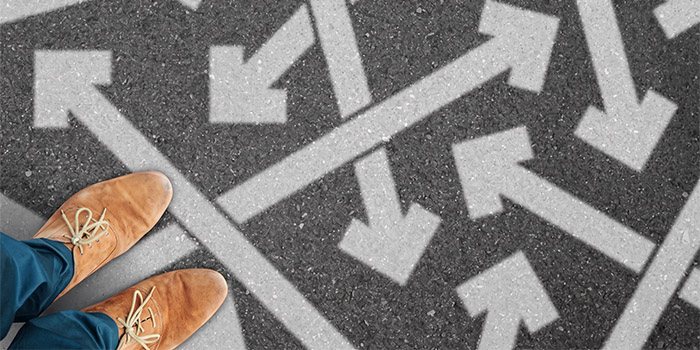
Long-term life management doesn’t come from willpower but from the physiological resilience of the nervous system. Regular practice grows measurable stress tolerance. Read how you build a lasting nervous-system buffer.
In medicine, the body’s recovery capacity and ability to handle stress are measured by heart rate variability (HRV). High HRV shows the nervous system’s ability to shift flexibly from stress to rest. Chronic overarousal and strain lower it. Regular breathing and NSDR practice are known to raise physiological HRV. It is evidence of neuroplasticity: regular practice reshapes the structures of the brain and autonomic nervous system to be less reactive and more flexible.
What it feels like in practice
When you start practicing, you use the tools to get through the load of a single moment. As use continues over weeks, a deeper change happens. Users notice that everyday surprises, such as lost items, schedule changes or setbacks, which used to trigger chaos, feel like mere speed bumps. The fuse gets longer and reactivity drops. The experience moves from surviving to a strong, steady baseline: you’ve built a nervous-system buffer in your body that carries you through the day.
Don’t believe a word. Try it.
Two practices straight from the app, complete and free. No sign-up, no email first. Put on headphones, sit down with your back straight and do the practice all the way through. The effect comes at the end, not at the start.
Nervous System Reset
A long exhale brings the nervous system down from overdrive into rest. Rhythm 4-4-8, three rounds. No previous experience needed.
Use the player above. It's best to listen with headphones in a calm place.
A breathing exercise does not replace treatment or medication. If you are pregnant, or have epilepsy, a heart condition, high blood pressure or a severe respiratory illness, ask your doctor first. Don't listen while driving.
Wave of Wellbeing
Releases the stress state and leaves a calm, harmonious feeling. Suitable at any point in the day.
Use the player above. It's best to listen with headphones in a calm place.
A breathing exercise does not replace treatment or medication. If you are pregnant, or have epilepsy, a heart condition, high blood pressure or a severe respiratory illness, ask your doctor first. Don't listen while driving.
No diagnosis needed
Regulating the nervous system isn’t an ADHD-only matter. Breathing affects the autonomic nervous system the same way in everyone, and two parts of the app work without any ADHD background: the SOS button for when your revs run away or you get stuck, and your own routine, which you build from your own goals.
This is designed for ADHD brains, which is exactly why it doesn’t require reading and doesn’t assume you can concentrate. The same qualities make it usable when you’re simply tired, overloaded, or can’t get your thoughts to settle in the evening.
When we’ve talked about this with people, the most enthusiastic have often been exactly the ones without a diagnosis.
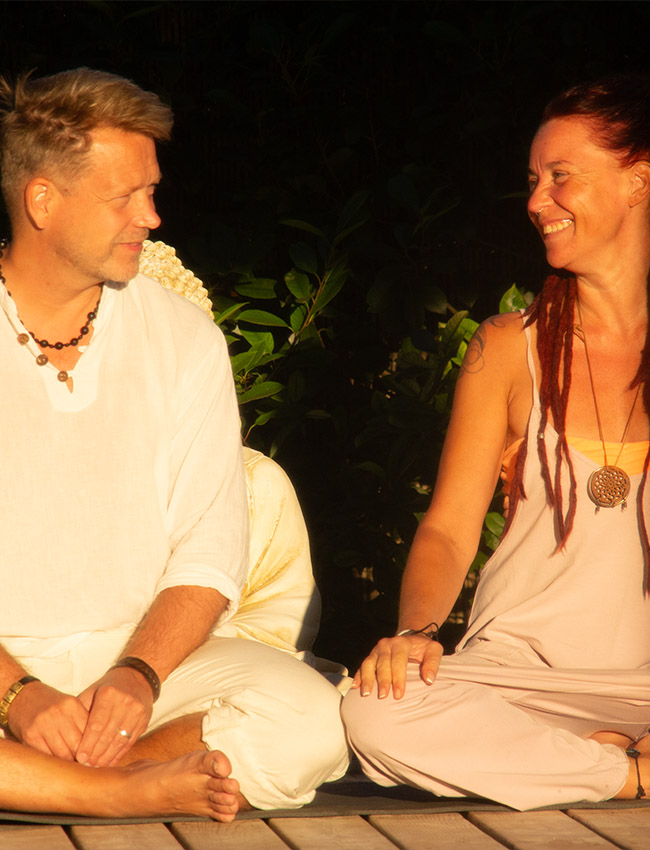
Two coaches, thirty years with the nervous system.
ADHD Momentum isn’t backed by a software company. It’s backed by Satu Valero, a solution-focused wellbeing coach who has ADHD herself, and Joakim Kaipainen, who has done nervous-system regulation work with kundalini yoga and pranayama since 2005.
One knows what it’s like on the inside. The other knows why it works. Neither would be enough alone.
Start with a free week.
Choose a plan below and we’ll email you the install link. The first 7 days are free and risk-free: you’re charged only after the trial, and you can cancel any time before then to pay nothing.
€119
The whole year at once. It renews automatically every year, and you can cancel any time. The first charge comes only after the 7-day trial.
€27
/month
If you’d like to try it month by month. You can cancel any time. The first charge comes only after the 7-day trial.
After payment we’ll email you the install link and sign-in instructions. The app is available for both iPhone and Android, in Europe too. Subscription details are in the terms of subscription.