
You already have these people.
The question is which side of the coin they’re on.
The app is now available for iPhone and Android. Your whole staff can try it free for two weeks, and the order is sized by how many people take it up.
A person with ADHD is the fastest in a crisis and irreplaceable in creative work. The same person under strain is on sick leave. The difference isn’t attitude or skill. It’s the state of the nervous system.
Strength and cost are the same thing
ADHD isn’t a separate set of good and bad traits. It’s one trait with two sides, and which side shows depends on the state of the nervous system.
Quick reactions are what save the day in a crisis.
The same speed becomes a cycle of interruptions where nothing gets finished.
The ability to dive in is the hyperfocus that produces a week’s work in one evening.
The same absorption is insomnia and an evening that stretches to two in the morning.
Directness is the voice in the meeting that says what everyone else is thinking.
The same directness is a conflict that takes a week to sort out.
You don’t choose which side you get.
The state of the nervous system does. It can be influenced, and that costs less than the consequences.
The numbers are public
Growth, adjusted for inflation
Over one in three sick days compensated by Kela is mental-health-related. The growth hasn’t levelled off. These aren’t ADHD figures but strain figures, yet ADHD brains become overloaded faster and recover more slowly, and that shows up in exactly these statistics.
We don’t claim that absences will stop. Nobody can promise that. We simply calculate what one day is worth, and a 50-seat annual package costs a fraction of it.
If the program saves one day, it has paid for itself many times over. In a pilot we measure the change, and you’ll see the results within three months.
Calculate your own figure
The calculation above uses averages. Nine questions about your organization’s everyday life are enough to replace it with a figure for an organization of your size, alongside a picture of how much capacity you already have unused.
The questions are about practices, not individual people. You don’t assess anyone, and we don’t collect information about your employees. Every number in the calculation is public and its source is shown in the result, so you can check it yourself before taking it any further.
Not a lecture series. A tool that stays with you.
Momentum is an app built for ADHD brains, available in English and Finnish. It doesn’t teach time management or hand out lists of tips, because the problem isn’t a lack of knowledge. Everyone knows what they should do. Starting, continuing and finishing fall apart on the state of the nervous system.
An assessment that meets the person
Everyone starts with an assessment that shows the current state of their nervous system. After that, a four-week guided path begins.
A four-week foundation
First the nervous-system foundation is built: guided breathing exercises, a morning activation, a body scan.
SOS one tap away
In the middle of a working day there are moments when the pace runs away or a person freezes. The SOS tools are for those, and they are always one tap away.
Your own routine after four weeks
On top of the foundation, everyone builds their own program from their own needs. Use doesn’t end when a course ends, because there is no course. There’s a tool.
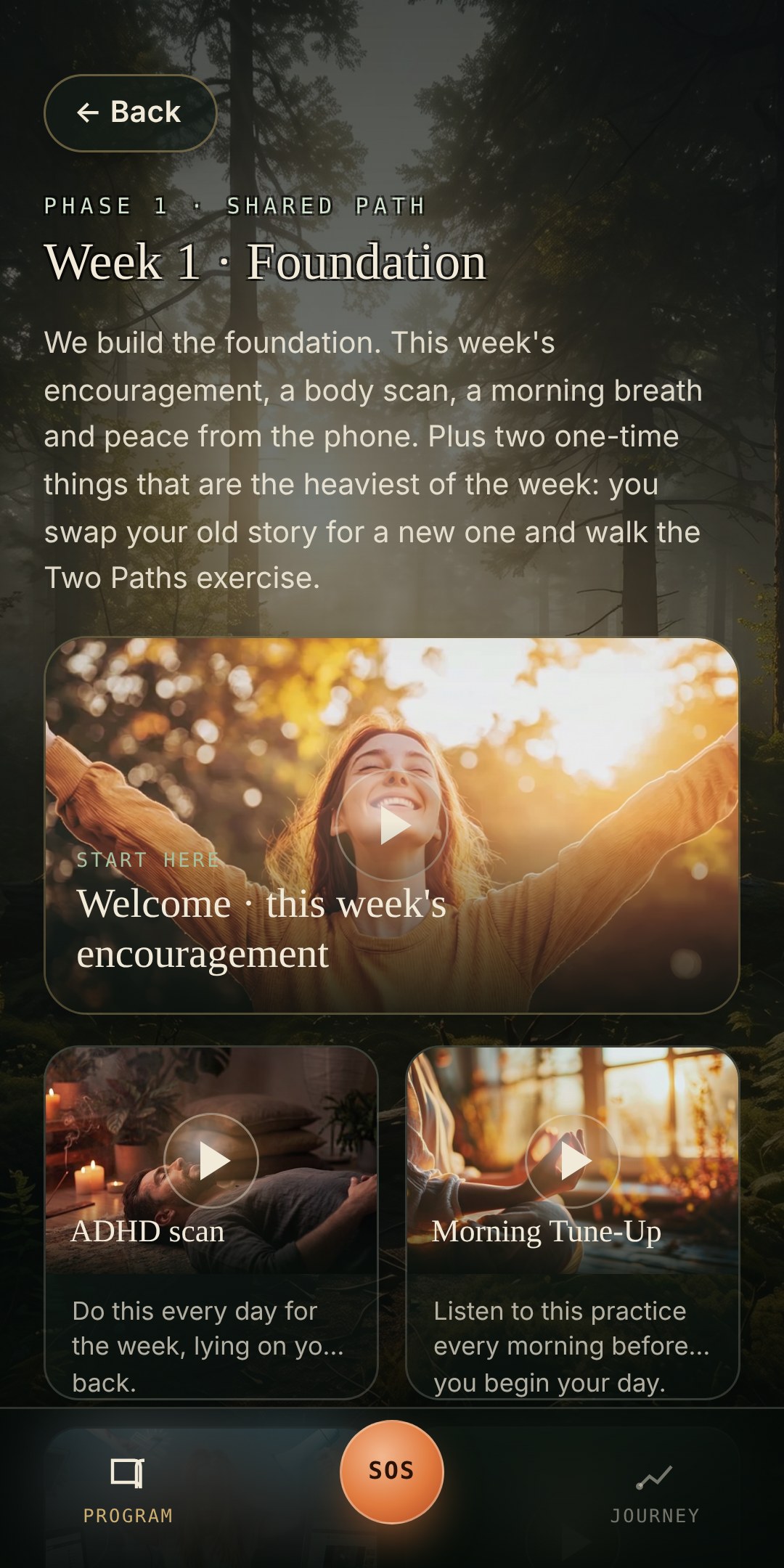
The four-week program starts with the foundation. This is what week 1 looks like to the user.
You buy seats, not names
The employer can’t see, and can’t get information on, who uses the app or what each person does. Users create an account with whatever email they like. A work email isn’t required. Reporting is always aggregated, and no individual user can be identified from it. If there are fewer than five active users, usage figures aren’t reported at all. You will always learn how many seats have been taken into use.
Written into the contract
It isn’t a technical detail but a condition for adoption. Nervous-system strain is something many people don’t want their employer to know about, and if they suspect it, they won’t open the app even once.
How access is shared
You receive one code with an agreed number of seats. You share it with your employees however you like: on the intranet, by email or at an information session.
An employee downloads the app, opens I have a code and types it in. The seat is reserved at that moment. Once the seats are used, the code no longer opens new ones.
The account belongs to the employee
They log in with whatever email address they like. A work email is neither required nor suggested. The account and the progress built up in it are theirs, and they remain even if the employment ends. If they want to continue on their own, they can get a membership at their own expense and nothing has to start from scratch.
Moving a seat
When a person leaves the organization, their seat can be released back for someone else. Their own account stays with them, but the membership ends.
When the contract or pilot ends
Access continues for another 14 days so that nobody drops out in the middle of an exercise. After that the account and progress remain, but new exercises and recordings close.
The data controller is ADHD Momentum, not the employer
The organization buys access rights. It doesn’t process its employees’ personal data through this service, which simplifies the data processing agreement considerably. The data is within the EU, and users can delete their account and all their data themselves from inside the app.
Pricing
| Seats | Price / seat / year | Example |
|---|---|---|
| 10–29 | €79 | 20 seats: €1,580 |
| 30–99 | €59 | 50 seats: €2,950 |
| 100–299 | €45 | 150 seats: €6,750 |
| 300–999 | €35 | 500 seats: €17,500 |
| 1,000+ | Institutional license | Unlimited users, ask for a quote |
Prices exclude VAT (0 %), invoiced. Minimum order €1,500.
For comparison: occupational health typically costs €300–600 per person per year, and workplace wellbeing budgets are around €100–300. Fifty-nine euros is about a quarter of a typical per-person budget.
On multi-year contracts: two years −10 %, three years −15 %.
Don’t try to count them
The most common question around the price list is how many seats to buy. There is no answer: you don’t know which of your people have ADHD traits, and you shouldn’t. We won’t tell you either. Many people don’t know it about themselves.
It’s worth changing the question. Regulating the nervous system isn’t an ADHD matter. The SOS tools and building your own routine work for anyone who wants support for nervous system balance and coping at work: a shift worker, a parent in the busiest years, a manager who can’t switch off their thoughts in the evening. It’s designed for ADHD brains, and that is exactly why it doesn’t require reading and doesn’t assume you can concentrate.
Partial distribution breaks anonymity. If twelve people out of sixty get a seat, they are the ones who become identifiable the moment they receive it. The anonymity promised above holds only if nobody stands out.
We therefore recommend giving access to the whole staff, a whole team or a whole unit, not to individuals picked out. And you don’t have to decide the number in advance at all: the two-week trial below shows how many people take it up.
Two weeks, the whole staff
You don’t have to guess how many seats you need. We give you one organisation code that works for your whole staff, and everyone can try the app free for two weeks. The app works in Finnish and English, so colleagues in either language can use it.
After the trial you see how many people took up the app, and you order the annual seats for that number. The seat count is always visible to you, but never who the users are. Each user’s access lasts two weeks from the moment they enter the code.
Three months, measured
The two-week trial shows how many people take an interest. A pilot shows what using the app changes: the same assessment is done at the start and at the end, and you get a final report in which the change shows up as numbers. The pilot is optional, and it can follow the trial or be chosen instead of it.
30 seats · 3 months · kick-off and closing webinar · interim and final report
50 seats · 3 months · kick-off and closing webinar · interim and final report
The price of the pilot is credited in full toward an annual contract if the contract is made within 30 days of the pilot ending. The contract year is counted from the start of the pilot.
Your risk is zero.
Where to start
Workplace wellbeing and HR
Employees under strain, no diagnosis required. The quickest decision and the most natural first group.
Teaching and early childhood education
High strain, a ready-made group, a clear measurement point.
Youth work
Young people with ADHD traits as the target group, often without a diagnosis and without any tools.
Nobody is required to have a diagnosis. The program suits anyone as support for nervous system balance and coping at work. It’s just designed for ADHD brains.

Strain doesn’t show on the outside. That’s why it can grow for a long time before anyone steps in.
So you know what you’re buying
Momentum is not treatment and not a healthcare service. It doesn’t replace occupational health, therapy, coaching or medication, and it takes no position on anyone’s medication.
Nor is it a diagnostic tool. The assessment shows the state of strain, not a diagnosis.
It’s a nervous-system regulation tool that is in your pocket when you need it, and that is why it works in everyday life, where a professional’s appointment has a three-week queue.

Two coaches, not a software company.
Satu Valero is a solution-focused wellbeing coach who has ADHD herself. Joakim Kaipainen has worked on nervous-system regulation through kundalini yoga and pranayama since 2005, and built the app himself: the exercises, the program structure and the technology.
You deal directly with us, including during the pilot. Questions are answered by the person who made the program.
Request a quote
Tell us the size of your organization and the group you have in mind, and I’ll send a quote within two working days. If you don’t yet know which suits you, the two-week trial, a pilot or an annual contract, write that down. It gets sorted out in one conversation.